
Motion Artifacts in CBCT:
Why They Occur and How to Reduce Them
Motion is one of the most common challenges in CBCT imaging.
A patient may move only slightly during a scan, yet the resulting image can show blur, double contours, streaks or geometric distortion. In some cases, motion can also interact with other artifacts and make fine anatomical detail more difficult to interpret.
Unlike many image-quality issues, motion begins during data acquisition. Once projection data have been affected by movement, post-processing cannot always fully recover the information that was lost.
Understanding how motion artifacts form is therefore an important part of achieving consistent CBCT image quality.
What Are Motion Artifacts?
CBCT creates a 3D volume from a series of 2D projection images acquired from different angles around the patient.
For reconstruction to work accurately, the anatomy should remain in essentially the same position throughout the acquisition.
If the patient moves between projections, the system receives information that no longer corresponds to exactly the same geometry. The reconstruction algorithm then has to combine inconsistent data.
The result can be blur, streaking, ghosting, double contours or distortion.
The principle is similar to taking a photograph while the camera or subject is moving. The difference is that CBCT reconstructs information from many projections, so movement can affect the volume in several different ways.
For a related explanation of how image detail is influenced by the complete imaging chain, see Voxel Size vs Spatial Resolution: What Really Determines CBCT Image Clarity?
Why Does Motion Occur During CBCT Scanning?
Movement does not always mean that a patient has deliberately changed position.
During a CBCT scan, motion may come from:
- movement of the head or body
- changes in posture
- swallowing or jaw movement
- difficulty maintaining a fixed position
- involuntary movement
- equipment vibration or mechanical instability
Children, older patients and people who find it difficult to remain still may be particularly sensitive to positioning and acquisition time.
Even relatively small changes in position can influence fine-detail imaging because CBCT reconstruction depends on geometric consistency across the complete projection dataset.
How Motion Affects CBCT Images
The appearance of a motion artifact depends on when the movement occurs, how long it lasts and how far the anatomy moves.
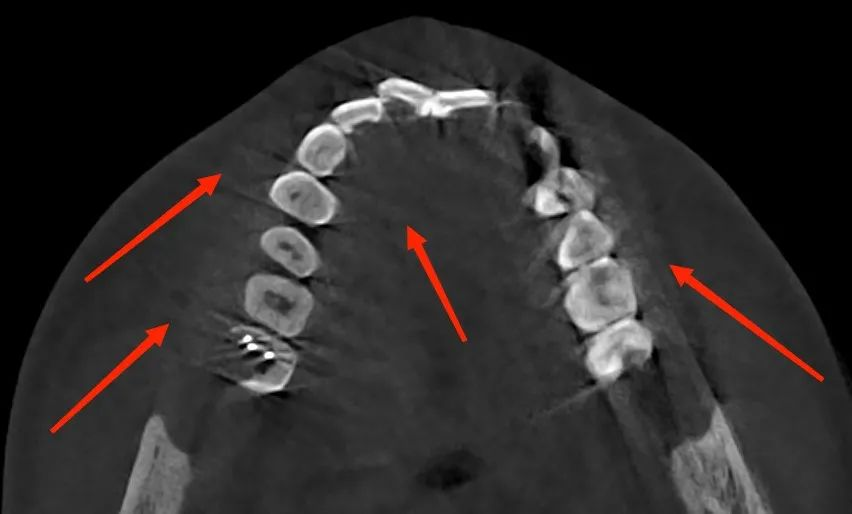
Sudden Movement
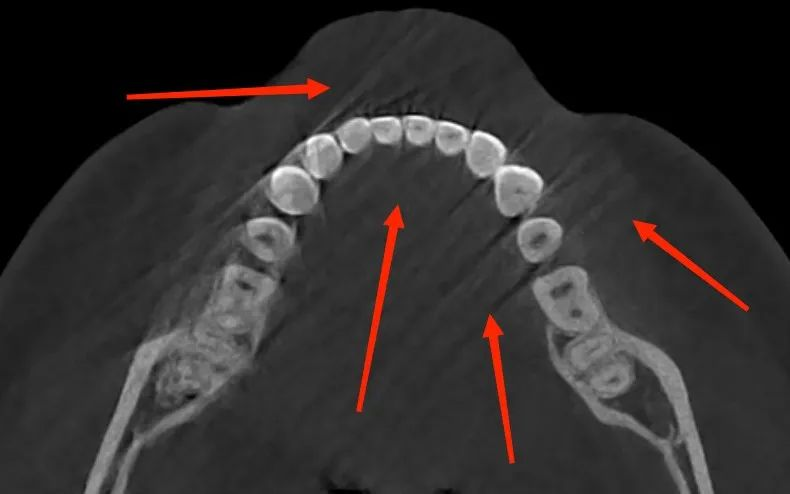
A brief movement during acquisition may produce streaks or oblique lines across the reconstructed image.
 |
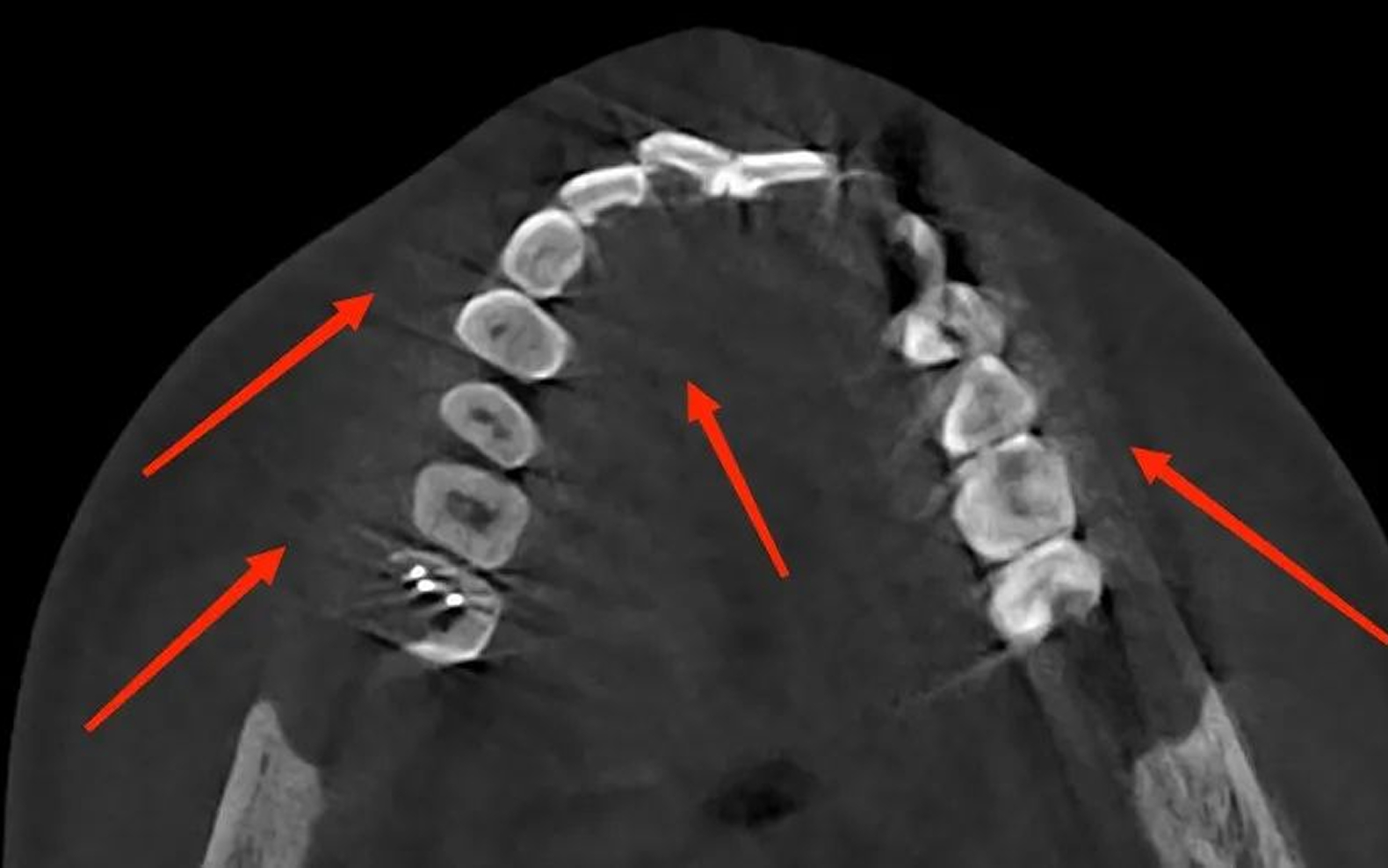 |
Diagonal streak artifacts caused by sudden movement during CBCT acquisition.
Displacement During Scanning
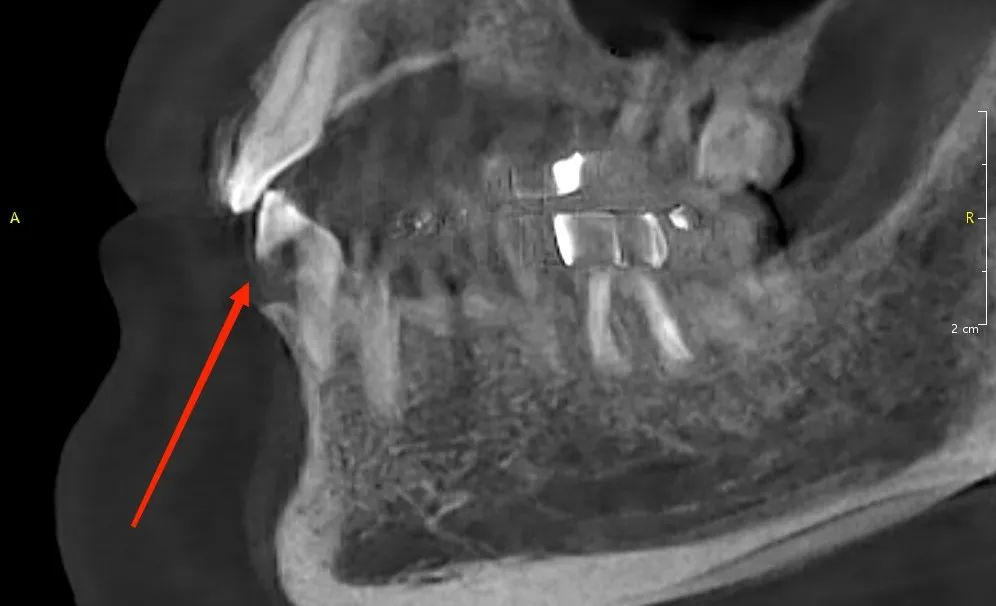
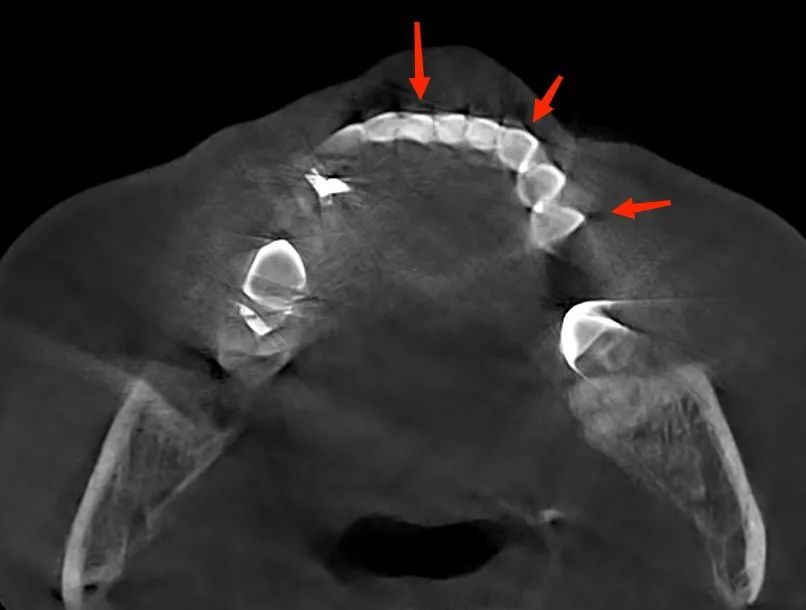
If the patient's position changes during part of the scan, anatomical structures may appear more than once.
This can create double contours, ghosting or blurred edges around teeth and bone.
Importantly, an image may still appear structurally complete while fine internal detail has already been affected.
|
Tooth ghosting |
Dark shadow along the alveolar bone margin |
Continuous Small Movement
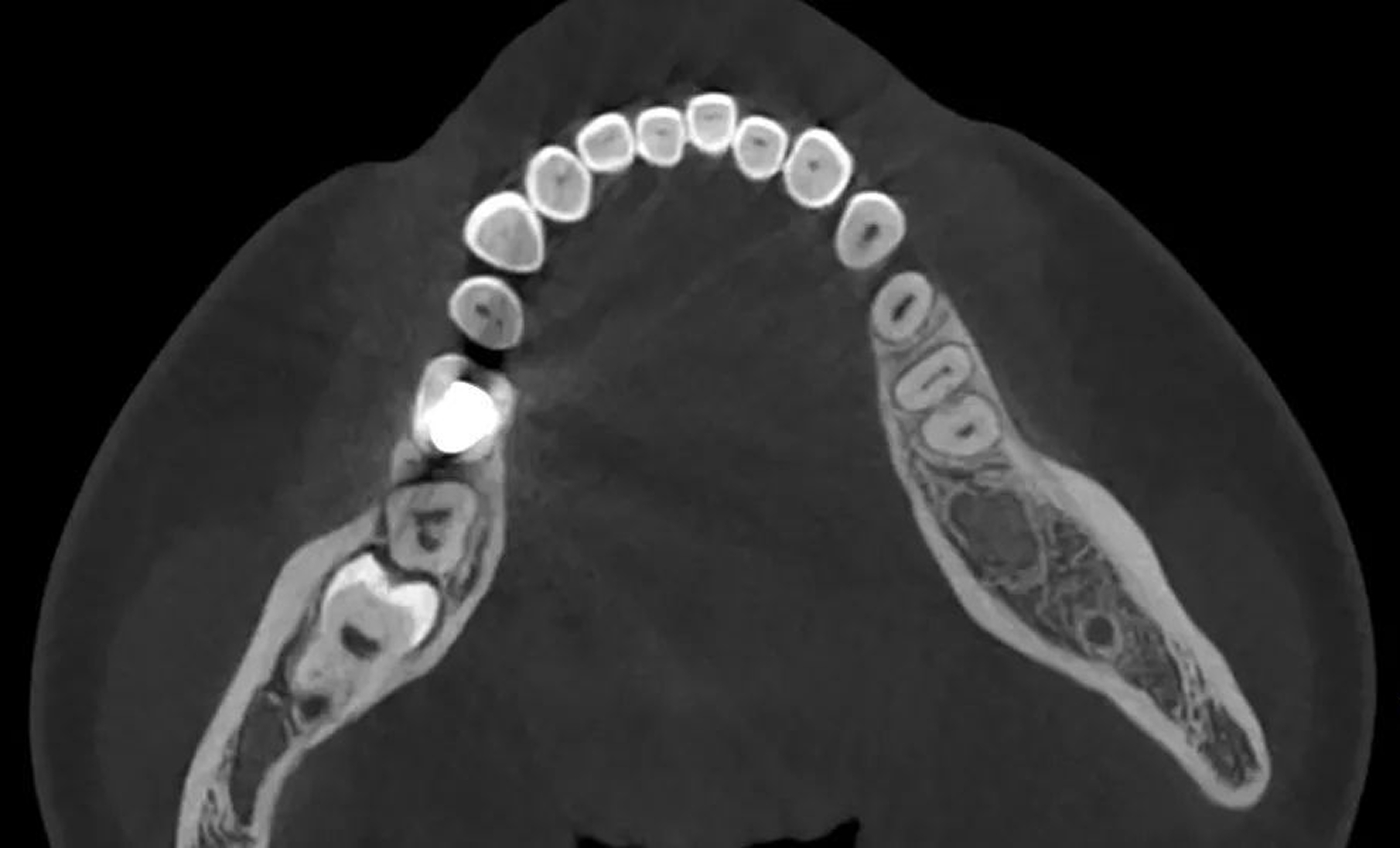
Repeated small movements can reduce edge definition and alter the apparent geometry of anatomical structures.
In cross-sectional views, this may appear as blur or distortion of tooth shape and surrounding bone.
|
Geometric distortion of the tooth in cross-sectional view |
Motion Can Also Interact With Other Artifacts
Motion does not always appear in isolation.
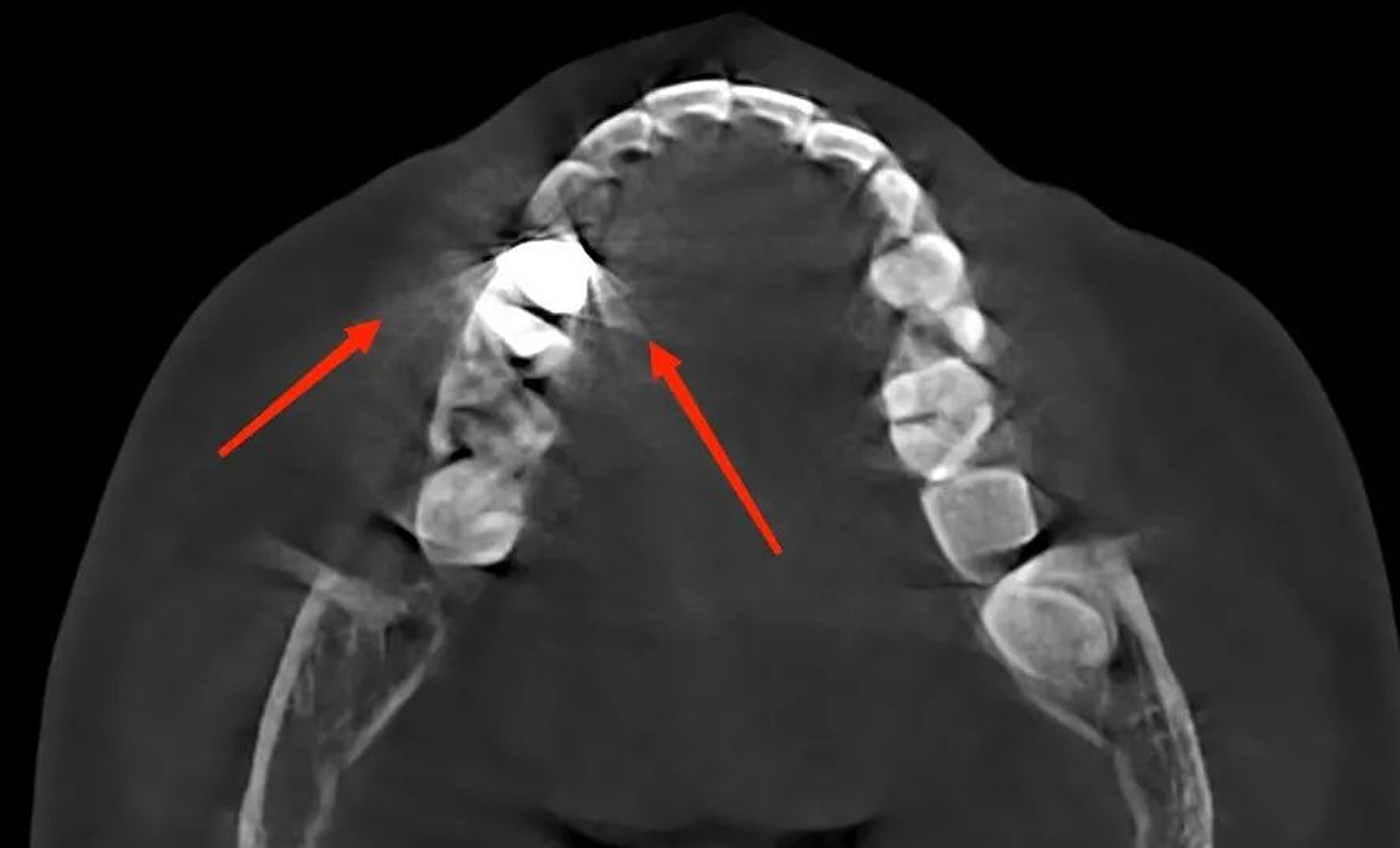
For example, metal already presents a challenging imaging environment because of attenuation, scatter and reconstruction effects. If the patient moves while metal objects are present, the position of those objects changes between projections.
This additional inconsistency can make artifact correction more difficult and may leave residual streaks around high-density structures.
In other words, movement can sometimes amplify or complicate artifacts that originate from other sources.
|
After metal artifact reduction under stable conditions |
Motion-related residual “metal artifact” cannot be eliminated |
Why Motion Is Difficult to Correct Afterwards
Many image-processing techniques can reduce noise, suppress metal artifacts or improve visual presentation.
Motion is different.
Once anatomical structures have moved between projections, some of the original geometric information has become inconsistent. Software may reduce the visible effect of motion in certain situations, but it cannot reliably reconstruct information that was never acquired consistently.
For this reason, the most effective approach is usually to reduce motion during acquisition rather than rely on correction afterwards.
How Can Motion Artifacts Be Reduced?
Reducing motion requires more than one solution. Patient preparation, positioning, acquisition protocol and system design all contribute.
Clear patient guidance helps patients understand when they need to remain still and avoid swallowing or unnecessary jaw movement.
Stable positioning helps maintain consistent head alignment throughout the acquisition.
Comfortable support is particularly important for patients who may find it difficult to maintain a fixed position.
Appropriate scan protocols can reduce the opportunity for movement. Where clinically suitable, a more efficient acquisition can help shorten the period during which the patient must remain still.
Mechanical stability also matters. Movement within the imaging system itself can introduce geometric inconsistency even when the patient remains stationary.
The objective is not to assume that motion can always be eliminated. It is to design the complete acquisition process so that unnecessary movement is kept as low as reasonably possible.
Designing Stability Into the Imaging Process
At YOFO, motion management is considered from both the patient and system sides.
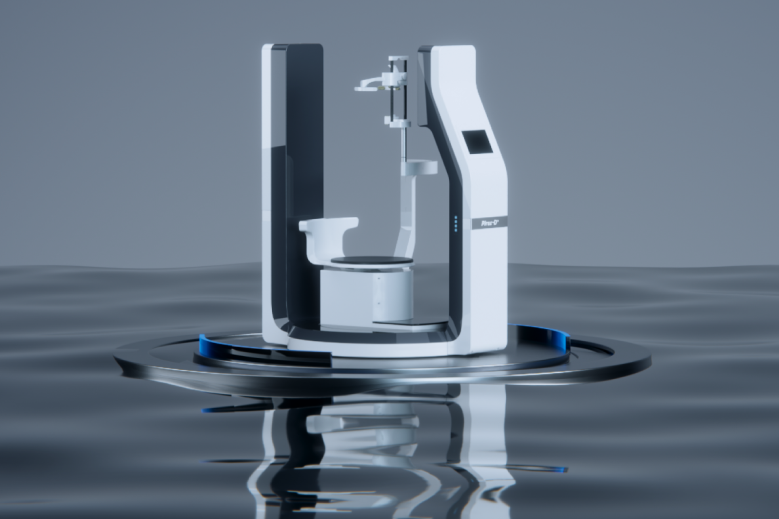
With Pirox dental CBCT, the top-open seated design provides an open scanning environment while allowing the patient to remain supported during acquisition. Multi-point head positioning helps maintain alignment and a stable mechanical architecture supports consistent system movement during scanning.
These design elements work together with detector performance and reconstruction algorithms as part of the wider imaging chain.
Because high image quality does not depend on one specification alone.
It depends on maintaining consistency from the moment the first projection is acquired to the moment the final volume is reconstructed.
Key Takeaway
Motion artifacts occur when the position of the patient or imaging system changes during CBCT acquisition. They can cause blur, ghosting, streaks and geometric distortion and can also make other artifacts more difficult to control.
Post-processing may reduce some visible effects, but prevention during acquisition remains important.
Stable positioning, clear patient guidance, appropriate scan protocols and mechanically stable system design all help preserve the detail captured in the final CBCT image.
 Explore Pirox
 Explore Hiroxis
_1.png) 40%
40% 80%
80%_1.png) 300+
300+ 20+
20+ 1,000+
 NO.1
NO.1





_1.png)